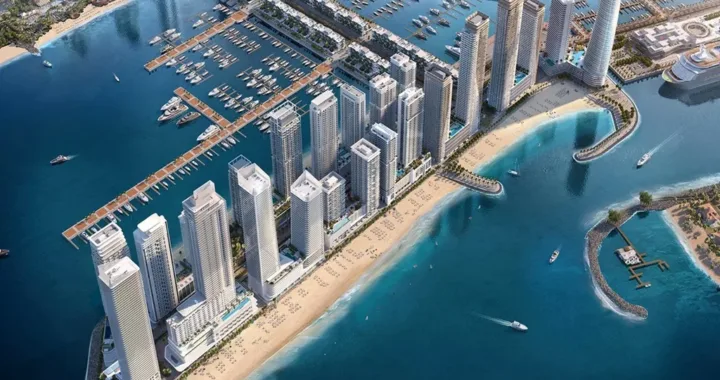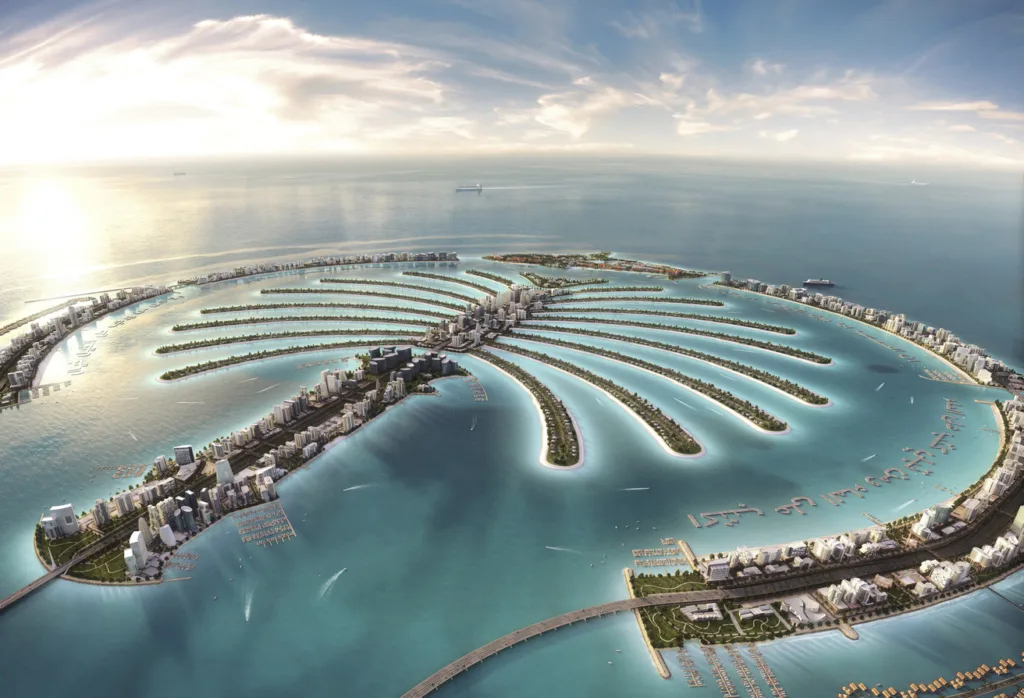
Palm Jebel Ali is a large man-made archipelago off Dubai’s southwestern coastline, near Jebel Ali. Nakheel is developing the project as part of Dubai’s wider southern growth corridor.
The location is important because Palm Jebel Ali is away from central Dubai. It connects the Jebel Ali coastal area with Dubai’s southern development corridor, including Dubai South, Expo City Dubai and Al Maktoum International Airport.
The master plan covers about 13.4 sq km. It includes seven interconnected islands and 16 fronds. The development is planned to add about 110 km of coastline and more than 90 km of beachfront. The master plan is expected to accommodate around 35,000 families.
For buyers and investors, Palm Jebel Ali is best understood as part of the wider Jebel Ali–Dubai South corridor. Its location should not be judged only by its distance from Downtown Dubai.
Where Is Palm Jebel Ali Located?
Palm Jebel Ali is located off the Jebel Ali coast, west of Palm Jumeirah and close to the Dubai-Abu Dhabi border.
The mainland location is also important. Several established residential, commercial, logistics and leisure areas surround Palm Jebel Ali.
The closest major areas include:
- Port Jebel Ali
- Jebel Ali Free Zone (JAFZA)
- Jebel Ali
- Jebel Ali Village
- Downtown Jebel Ali
- Dubai Waterfront
- Badrah
- Veneto
- Jebel Ali Hills
- JA Resort and Golf Club
Palm Jebel Ali therefore has a different location profile from Palm Jumeirah. Palm Jumeirah is closer to Dubai Marina and the central coastal areas. Palm Jebel Ali is farther southwest and has stronger links to Jebel Ali, logistics areas and Dubai’s southern growth corridor.
Palm Jebel Ali and Jebel Ali Free Zone
JAFZA and Port Jebel Ali are major economic centres near Palm Jebel Ali.
JAFZA has a large base of logistics, manufacturing, trading and industrial businesses. Port Jebel Ali is also a major maritime and logistics hub.
This creates a practical connection for people working in Jebel Ali and nearby employment areas.
Palm Jebel Ali is therefore linked to an established economic base. Its location is not dependent only on tourism, leisure and residential demand.
For investors, nearby employment centres can also be relevant because they provide a wider potential customer base for residential property.
Dubai Waterfront and the Mainland Connection
Dubai Waterfront is one of the closest mainland areas to Palm Jebel Ali.
The connection between the island and mainland is an important part of the development plan.
A planned public access road will connect Palm Jebel Ali with Sheikh Zayed Road through the Dubai Waterfront area. The road is nearly 6 km long.
Infrastructure work also includes roads, utilities and connections across the fronds and Spine District. In 2025, Nakheel announced infrastructure contracts worth more than AED 750 million for roads and utility networks across parts of the development.
This infrastructure will play an important role as more homes, retail facilities and hospitality projects become operational.
Palm Jebel Ali Access to Sheikh Zayed Road
Sheikh Zayed Road, or E11, is the main highway serving Palm Jebel Ali.
The road provides access in two main directions.
Toward Central Dubai
E11 connects the Jebel Ali area with Dubai Marina, Bluewaters Island, Jumeirah and other central parts of Dubai.
Toward Abu Dhabi
The same highway provides access toward Abu Dhabi and communities along the Dubai-Abu Dhabi corridor.
Palm Jebel Ali is also planned to have three access points to the island.
For a large island development, road access is important for daily life. The location will depend not only on its waterfront setting but also on how easily residents can reach the mainland, workplaces and nearby communities.
Nearby Leisure and Entertainment Areas
Palm Jebel Ali is close to several established leisure and entertainment destinations.
Dubai Parks and Resorts
Dubai Parks and Resorts is located along the Dubai-Abu Dhabi corridor. It is one of the major entertainment destinations near Jebel Ali.
Its location adds an established leisure destination to the wider southern Dubai area.
JA Resort and Golf Club
JA Resort and Golf Club is located near Jebel Ali’s established coastal area.
The resort offers golf, hospitality, beach and recreational facilities. It has also been part of the Jebel Ali area for many years.
Ibn Battuta Mall
Ibn Battuta Mall is another established destination within the wider Jebel Ali and Dubai Marina corridor.
The mall provides retail, dining and everyday services for residents in nearby communities.
These existing destinations are relevant because Palm Jebel Ali is still developing. Residents can use facilities in nearby areas while the island develops its own retail, dining and leisure options.
Dubai South and Expo City Dubai
The connection between Palm Jebel Ali and Dubai’s southern growth corridor is one of the key location factors.
Dubai South is a large planned urban and logistics district. It includes residential, commercial, aviation and logistics areas.
Expo City Dubai is located farther inland and has become another major development centre in southern Dubai.
Palm Jebel Ali is therefore part of a wider area where residential, logistics, aviation, commercial and leisure projects are developing at the same time.
This wider economic base is relevant when assessing future residential demand around Palm Jebel Ali.
Al Maktoum International Airport
Al Maktoum International Airport, also known as Dubai World Central, is another major infrastructure project in southern Dubai.
The airport sits within the wider Dubai South area and is expected to become increasingly important to Dubai’s aviation network.
For Palm Jebel Ali, this provides another long-term location advantage.
However, the actual benefit will depend on airport expansion, road infrastructure and the continued growth of Dubai South. It is therefore better viewed as a long-term connectivity factor rather than an immediate travel-time benefit.
Palm Jebel Ali vs Palm Jumeirah Location
Palm Jebel Ali and Palm Jumeirah have similar palm-shaped designs, but their locations serve different purposes.
| Factor | Palm Jebel Ali | Palm Jumeirah |
| Position | Southwestern Dubai | Central coastal Dubai |
| Nearby economic base | Jebel Ali, JAFZA, logistics and southern corridor | Dubai Marina, Media City, Internet City and central coastal areas |
| Airport connection | Stronger connection to DWC | Stronger connection to DXB |
| Development stage | Large-scale new development | Established community |
| Waterfront scale | 7 islands and 16 fronds | Established island community |
| Main road | Sheikh Zayed Road | Sheikh Zayed Road |
| Development focus | Residential, retail, hospitality and leisure | Residential, hospitality, retail and leisure |
| Long-term role | Southern coastal expansion | Established coastal district |
This comparison shows why distance from Downtown Dubai does not give a complete view of Palm Jebel Ali.
Its residential and investment profile is closely linked to the continued growth of southern Dubai.
Palm Jebel Ali’s Internal Districts
Palm Jebel Ali is planned as a large mixed-use destination rather than one residential neighbourhood.
Different parts of the master plan have different roles.
The Fronds
The fronds are mainly planned for waterfront residential development.
Current villa releases include five-, six- and seven-bedroom beachfront homes. In August 2026, Nakheel announced 44 additional villas on Frond F across the Beach and Coral Collections.
The Spine
The Spine forms a central part of Palm Jebel Ali. It includes infrastructure, residential and mixed-use development.
Palm Central Private Residences introduced apartments and townhouses to the island. In June 2026, Nakheel announced another release of 222 residences across three buildings.
This adds more variety to Palm Jebel Ali’s residential market. The development is not limited to large waterfront villas. Apartments and townhouses also provide different price points and housing options.
Retail and Community Facilities
Palm Jebel Ali’s planned community facilities include a 9,000 sq m retail centre and a Friday Mosque with capacity for up to 1,000 worshippers.
In September 2026, Dubai Retail also announced The Yard, a new waterfront retail and lifestyle destination planned to open in 2027. It is expected to provide around 70,000 sq ft of gross leasable area with 26 retail, dining, wellness and healthcare concepts.
These facilities will become more important as the island gains residents.
Palm Jebel Ali Development Progress in 2026
One of the main changes in 2026 is the move from planning into active construction and delivery.
Nakheel reported in August 2026 that more than AED 13 billion in construction and infrastructure contracts had been awarded. Construction was progressing across the residential fronds. The first villa handovers were scheduled to begin in late 2026 and continue through 2027.
In April 2026, Nakheel also awarded contracts worth more than AED 3.5 billion for 544 villas across Fronds A to F. These villas have a targeted completion date of Q4 2028.
This is important for buyers because Palm Jebel Ali is still a developing community.
It cannot yet be compared with a fully established Dubai community where all services and facilities are already operating. Buyers should check the construction schedule, expected handover date, road access and nearby infrastructure for each individual project.
What the 2026 Dubai Property Market Means for Palm Jebel Ali
Dubai’s wider property market remains active in 2026, but market-wide growth does not mean every project will perform in the same way.
Dubai recorded AED 252 billion in total real estate transactions during Q1 2026, up 31% year on year, across 60,303 transactions. Real estate investment value reached AED 173 billion, while foreign investment value reached AED 148.35 billion.
Residential activity also remained strong during H1 2026. Top Ultra Luxury reported 80,509 residential sales worth AED 226.5 billion. Off-plan properties accounted for 71.3% of residential sales in its dataset.
This is relevant to Palm Jebel Ali because much of its current residential supply is being sold before completion.
However, Dubai-wide market figures should not be used to assume that every Palm Jebel Ali property will perform in the same way.
Factors such as launch price, payment plan, developer delivery, unit size, waterfront position, service charges and future rental demand can affect individual properties.
Why Location Analysis Should Go Beyond Drive Time
Drive times can help buyers understand location, but they do not tell the whole story.
Traffic on E11 can change during peak hours. Road construction can also affect travel times as the southern corridor continues to develop.
For Palm Jebel Ali, a useful location assessment should look at five factors:
- Access to E11
- Distance from JAFZA and Port Jebel Ali
- Connection to Dubai South and DWC
- Availability of retail and community facilities
- Progress of Palm Jebel Ali’s own infrastructure
This gives a more useful view than listing approximate travel times to every major Dubai destination.
Palm Jebel Ali Location: The Practical View
Palm Jebel Ali’s main location feature is its position within Dubai’s southern expansion corridor.
It combines a new waterfront destination with access to the established economic base around Jebel Ali. It also connects with Dubai South, Expo City Dubai and Al Maktoum International Airport.
The main consideration is development maturity.
Palm Jebel Ali has a large master plan, but several parts of the community are still under construction. Buyers should therefore check delivery schedules and current road access rather than rely only on the completed master plan.
By 2026, the project has moved well beyond the early planning stage. Construction contracts, infrastructure work, residential launches and planned retail facilities show clear progress.
For property research, Palm Jebel Ali is best assessed as part of the wider Jebel Ali–Dubai South corridor. Looking at the island together with its mainland neighbours gives a clearer view of access, employment, infrastructure and potential residential demand.