Palm Jebel Ali is moving into a very different phase in 2026.
For years, the project was mainly a long-term idea. Today, there are villas under construction, infrastructure contracts worth billions of dirhams, new apartment releases and a clearer delivery schedule.
That changes the investment question.
You are no longer buying into a project that exists only on a masterplan. But you are also not buying into a finished community like Palm Jumeirah.
That difference matters.
Palm Jebel Ali is still being built. The first villa handovers are expected from late 2026, with further deliveries continuing through 2027 and beyond. Other parts of the masterplan will take much longer.
For buyers, this means the location has a strong long-term story. It also means you need to look closely at the specific property, frond, payment plan and expected delivery date.
What is Palm Jebel Ali?
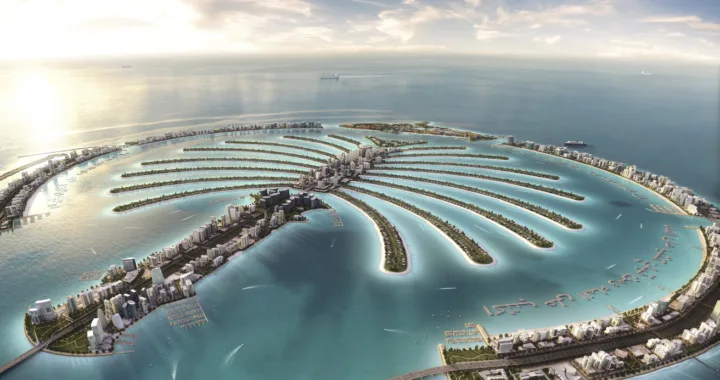
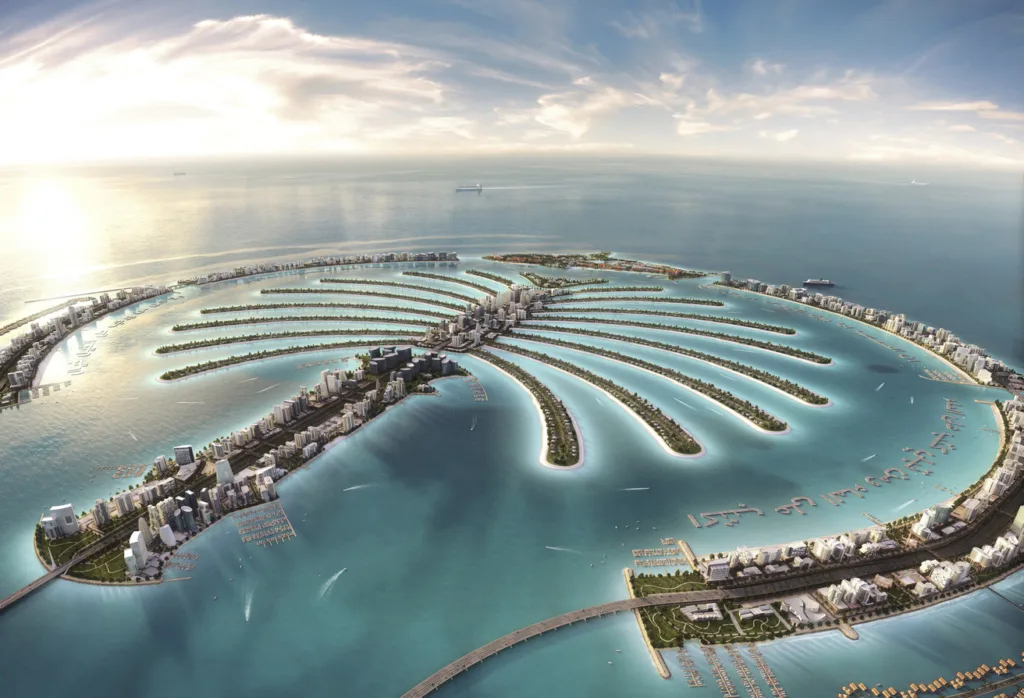
Palm Jebel Ali is Nakheel’s large waterfront development off Dubai’s western coast.
The masterplan consists of seven islands and 16 fronds. Nakheel properties currently describes the project as having around 120 kilometres of coastline and more than 90 kilometres of beachfront. The development stretches about 13.4 kilometres.
The scale is important.
This is not a small residential project with a few towers and villas. It is planned as a major waterfront district with homes, retail, hospitality, leisure facilities and community infrastructure.
The residential offer is also split into very different price points.
At the top are the Beach Collection and Coral Collection villas. At a lower entry point are the apartments and townhouses at Palm Central Private Residences.
That gives buyers two very different ways to enter Palm Jebel Ali.
Palm Jebel Ali construction status in August 2026
The biggest change this year is the amount of physical work taking place.
Nakheel says it has awarded more than AED 13 billion in construction and infrastructure contracts for Palm Jebel Ali.
Villa construction is now active across the residential fronds.
According to Nakheel’s latest August 2026 update:
- 728 villas on Fronds K–P have reached internal and external finishing stages.
- 544 villas on Fronds A–F are under construction.
- The 544-villa package was supported by contracts worth more than AED 3.5 billion.
- The first villa handovers are scheduled to start in late 2026 and continue through 2027.
There is another important part of the construction story.
Jan De Nul is completing the marine and reclamation works. Its latest project information says the final palm leaves and crown are being completed, with its archipelago works expected to finish in autumn 2026. Ground improvement works are part of the final preparation before construction.
So, if you visit Palm Jebel Ali today, do not expect a finished residential neighbourhood.
You will see a major construction site becoming a residential destination.
That is an important distinction for investors.
The 544-villa contract is a major delivery milestone
In April 2026, Nakheel awarded contracts worth more than AED 3.5 billion for 544 villas.
Ginco is responsible for 354 villas across Fronds A to D. United Engineering Construction is delivering another 190 villas across Fronds E and F.
Construction began during Q2 2026, with completion targeted for Q4 2028.
This is worth highlighting because Palm Jebel Ali has several construction timelines running at the same time.
Some earlier villa packages are targeting much earlier delivery. The newer A–F package has a later construction completion target.
So the phrase “Palm Jebel Ali handover” does not refer to one single date.
It depends on the frond and the property.
Palm Jebel Ali Beach Collection villas
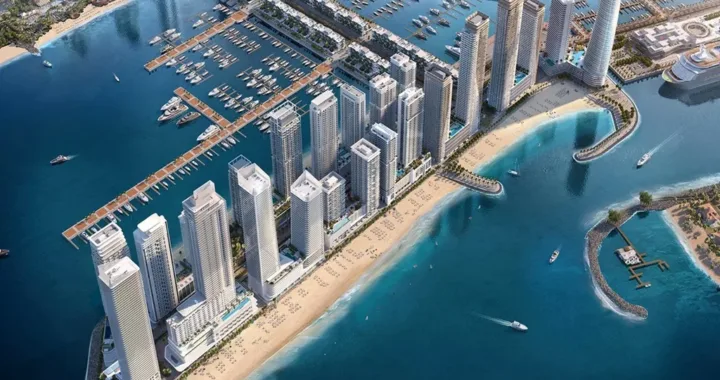
The Beach Collection is aimed at buyers looking for large beachfront villas.
The current Frond F release includes five- and six-bedroom villas.
Typical built-up areas are around 7,500 to 8,500 sq ft.
These homes have direct beach access and Arabian Gulf views.
Nakheel’s latest release includes four design studios:
- NAGA Architects
- SAOTA
- LW Design Group
- LOCI Architecture
The August 2026 release contains 44 villas across 10 designs, combining the Beach and Coral Collections.
That limited release is significant.
Palm Jebel Ali has a finite amount of beachfront land. Once the residential fronds are built, the supply of new beachfront villas on those fronds cannot simply be increased.
That scarcity is one reason the ultra-luxury segment attracts attention from high-net-worth buyers.
Coral Collection villas
The Coral Collection sits above the Beach Collection in terms of size.
The latest homes include six- and seven-bedroom villas ranging from roughly 11,500 to 12,500 sq ft.
These are large family homes rather than typical investment units.
The buyer profile is therefore different.
A buyer looking at a Coral villa is likely to care more about:
- Beach frontage
- Plot position
- Privacy
- Villa layout
- Views
- Architecture
- Outdoor space
- Long-term ownership value
Rental yield is usually not the main reason to buy a property at this price level.
The latest 44-villa release is especially interesting because Nakheel describes it as one of the final opportunities for new beachfront villas on the residential fronds.
How much do Palm Jebel Ali villas cost?
Pricing varies significantly by frond, villa type, size, view and release.
Recent registered transactions provide a useful reference point.
Market data based on Dubai Land Department records shows recent villa transactions around the AED 18 million to AED 23 million range for several six-bedroom homes of roughly 7,600–8,300 sq ft. Individual transactions can be much higher.
For example, recent recorded transactions included:
- Around AED 18.5 million for a 7,875 sq ft six-bedroom villa.
- Around AED 20 million for an 8,204 sq ft five-bedroom villa.
- Around AED 22.8 million for an 8,293 sq ft six-bedroom villa.
These are transaction examples, not current developer asking prices.
That distinction is important.
A developer launch price and a DLD-registered resale transaction are different data points.
Palm Central gives buyers a lower entry point
This is where Palm Jebel Ali becomes interesting for a wider group of buyers.
Palm Central Private Residences offers apartments and townhouses rather than the large standalone villas.
In June 2026, Nakheel released another 222 residences across three low- to mid-rise buildings.
The release includes:
- 1-bedroom apartments
- 2-bedroom apartments
- 3-bedroom apartments
- 4-bedroom apartments
- 4- and 5-bedroom townhouses
Nakheel says the homes have direct beach access and views across the Arabian Gulf.
The published starting prices reported for the June release were:
| Property | Starting price |
| 1-bedroom apartment | AED 2.7M |
| 2-bedroom apartment | AED 4.3M |
| 3-bedroom apartment | AED 7.5M |
| 4-bedroom apartment | AED 12.4M |
| 4–5 bedroom townhouse | AED 14.9M |
The target completion for this phase is around September 2030.
This creates a very different investment proposition from the AED 18M-plus villa segment.
A buyer can get a Palm Jebel Ali address with an entry price of AED 2.7M rather than starting in the ultra-luxury villa bracket.
Palm Jebel Ali prices per square foot
The price-per-square-foot story needs some care.
Different data providers produce different figures because they use different time periods, property mixes and methodologies.
Recent DLD-based datasets put Palm Jebel Ali around AED 3,500 per sq ft on a median basis for recent transactions. One August 2026 dataset reports AED 3,496 per sq ft, while Bayut’s July 2026 index shows AED 3,049 per sq ft across its tracked property set.
This tells you something useful.
Palm Jebel Ali is no longer being priced like an early-stage land development.
But you should not apply one area-wide AED-per-sq-ft figure to every property.
A 1-bedroom apartment and a 7-bedroom beachfront villa are completely different products.
For a proper comparison, use:
same property type + same bedroom count + similar size + similar location + similar view + similar construction stage.
That gives you a much better valuation benchmark.
Why Palm Jebel Ali could attract long-term investors
There are several reasons investors are watching the project.
1. Limited beachfront land
The amount of beachfront is large, but the supply of directly beachfront residential plots is still finite.
Once the residential fronds are developed, new comparable villa supply cannot be added easily.
This gives well-positioned beachfront homes a different supply profile from conventional apartment communities.
2. Dubai is expanding west and south
Palm Jebel Ali is part of a wider western Dubai growth corridor.
Jebel Ali, Dubai South, Expo City and Al Maktoum International Airport are all relevant to the area’s long-term development story.
This does not mean every nearby property will automatically rise in value.
But large infrastructure and employment centres can support housing demand over time.
3. The project is becoming physical
This is perhaps the most important change.
Investors can now see actual villas under construction.
AED 13 billion-plus in awarded construction and infrastructure contracts is also a useful measure of the capital being committed to delivery.
4. The product is different from normal Dubai housing
A Palm Jebel Ali villa is not competing directly with every villa community in Dubai.
The product is built around waterfront access.
That matters for buyers who value private beach access, sea views and large plots.
But there is a major point investors should understand
Palm Jebel Ali is not Palm Jumeirah today.
Palm Jumeirah has an established population, hotels, restaurants, retail, schools, road connections and a mature resale market.
Palm Jebel Ali is still being built.
This creates both opportunity and uncertainty.
The upside case depends on the wider masterplan being delivered as planned.
The future value of a home will depend partly on what surrounds it.
That includes:
- Roads
- Utilities
- Retail
- Hospitality
- Beach facilities
- Restaurants
- Community services
- Public spaces
- Marina facilities
- Access to the wider Dubai road network
The first residents will be living in a community that is still developing around them.
That is normal for a large master development, but buyers should price this into their decision.
Palm Jebel Ali’s future retail and community infrastructure
The residential properties are only one part of the plan.
The masterplan includes a 9,000 sq m retail centre.
There is also a planned Friday Mosque designed by Skidmore, Owings & Merrill, with capacity for up to 1,000 worshippers.
Nakheel also says the wider destination is planned to include more than 80 hotels and resorts, along with beach clubs, dining, leisure, wellness, civic infrastructure and public spaces.
These facilities matter because a waterfront development becomes much more useful once people can spend time there without leaving the island.
For property owners, that can also affect the long-term appeal of the location.
What does Palm Jebel Ali mean for Jebel Ali?
This is an important part of the story that often gets missed.
Palm Jebel Ali is not an isolated luxury island.
It sits within a much larger western Dubai growth area.
Jebel Ali already has a major industrial and logistics role. Dubai South is developing around aviation, logistics and residential uses. Expo City adds another employment and lifestyle node.
Palm Jebel Ali adds a premium residential and leisure component.
That combination could create a stronger housing ecosystem across the area over time.
But the effect will not happen overnight.
The first stage is construction.
The next stage is occupation.
Then comes the growth of supporting retail, hospitality and services.
Investors should think in those stages rather than expecting the entire masterplan to be operational in 2026.
Is Palm Jebel Ali better for investors or end users?
It depends on what you want from the property.
For an end user
Palm Jebel Ali can make sense if you want:
- A beachfront home
- A large villa
- More privacy
- Direct beach access
- Long-term ownership
- A new master-planned waterfront environment
The key question is not simply the price.
It is whether you are comfortable waiting for the surrounding community to mature.
For an investor
The calculation is different.
You should look at:
- Purchase price
- AED per sq ft
- Payment schedule
- Handover date
- Expected service charges
- Comparable transactions
- Rental demand
- Resale liquidity
- Supply coming to the market
- Developer track record
- Specific frond location
For Palm Central, the lower entry price makes the apartment segment easier to compare with other Dubai waterfront projects.
For the Beach and Coral villas, the investment case is more closely tied to scarcity, capital value and ultra-luxury demand.
What I would check before buying Palm Jebel Ali
I would not make the decision based on the Palm Jebel Ali name alone.
The island is too large for that.
Start with the exact property.
Check the frond
Frond location can affect views, beach position, road access and future surroundings.
Check the construction stage
Two properties on Palm Jebel Ali can have very different delivery timelines.
Ask for the latest official construction status.
Check the payment plan
A lower launch price does not automatically mean lower cash requirements.
Calculate every instalment up to handover.
Check the handover wording
Look at the SPA and official developer documentation.
Do not rely only on a sales presentation.
Compare recent transactions
Use DLD-registered transactions where possible.
For villas, compare similar sizes and bedroom counts.
For apartments, compare the same building type and similar floor plans.
Check the future surroundings
Look beyond the sea view.
Ask what will be built next to the property.
A future retail centre, road, hotel or public facility can change the character of a location.
Palm Jebel Ali vs Palm Jumeirah
The comparison is unavoidable.
Palm Jumeirah is the mature market.
Palm Jebel Ali is the development story.
Palm Jumeirah gives you established demand, existing infrastructure and a deeper resale and rental market.
Palm Jebel Ali gives you newer stock, larger development scale and an earlier position in the area’s growth cycle.
That does not make one automatically better.
They serve different buyers.
If you want an established luxury address today, Palm Jumeirah is the easier choice.
If you are comfortable with a longer development period and want exposure to a new waterfront district, Palm Jebel Ali deserves closer analysis.
The bigger investment question
The strongest argument for Palm Jebel Ali is not simply that it is another Palm.
It is the combination of limited waterfront land, major infrastructure spending, large villa inventory, new apartment supply and Dubai’s continued expansion toward the south and west.
But the project also needs time.
In 2026, you are buying into the next stage of development.
You are not buying into a finished lifestyle district.
That is why the specific property matters so much.
A well-positioned villa with a good beach frontage may have a very different long-term profile from an apartment that is priced aggressively against competing off-plan stock.
Palm Jebel Ali investment outlook for 2026
My view is straightforward.
Palm Jebel Ali has moved past the “future project” stage, but it has not reached the “mature community” stage.
That middle stage is where the opportunity sits.
The numbers show real progress:
- 7 islands
- 16 fronds
- 13.4 km development length
- 90+ km beachfront
- AED 13B+ construction and infrastructure contracts awarded
- 728 villas at finishing stages on Fronds K–P
- 544 additional villas under active construction on Fronds A–F
- 44 new Beach and Coral villas released on Frond F in August 2026
- 222 Palm Central residences released in June 2026
- AED 2.7M starting price for the latest Palm Central apartment release
- AED 14.9M starting price for its largest townhouse category
- First villa handovers expected from late 2026
Those numbers show a project moving from infrastructure work toward actual residential occupation.
The next test is delivery.
Can the roads, utilities, homes and community facilities come together at the expected pace?
Can the first residents get a good day-to-day living experience?
Can demand continue once more supply reaches the market?
Those are the questions I would watch over the next two to four years.
For buyers, Palm Jebel Ali can make sense if the property itself is right.
For investors, the better approach is to ignore the marketing headline and study the numbers for the exact unit.
The island has the scale. The capital is being spent. Construction is visible. Now the market needs to prove how well that translates into real residential demand and long-term property values.