Dubailand has changed a lot since it was first announced.
The original plan in 2003 was built around a huge entertainment destination. The 2008 financial crisis changed that direction. Over time, Dubailand became something more useful for Dubai’s housing market: a large suburban belt made up of residential communities, villas, townhouses and apartments.
Today, the name Dubailand covers a very broad property market. It includes established communities such as Arabian Ranches and DAMAC Hills, newer projects such as The Valley and Sobha Sanctuary, and apartment-led locations such as Arjan and Liwan.
That size matters.
You are not looking at one uniform property market. Prices, infrastructure, rental demand and the quality of community facilities can differ sharply from one part of Dubailand to another.
For a buyer or investor, the better question is not simply, “Is Dubailand a good place to buy?”
The better question is:
Which Dubailand community fits your budget, property type and holding period?
Why Dubailand remains important in Dubai real estate
Dubailand offers something that is harder to find in central Dubai: space.
Many communities are built around villas and townhouses. Others offer lower-priced apartments. Large master plans also allow developers to add schools, retail, parks, sports facilities and community centres as the area grows.
Road connectivity is another reason buyers consider the district. Major routes around Dubailand connect it with different parts of Dubai, including Emirates Road, Dubai–Al Ain Road and Sheikh Mohammed Bin Zayed Road.
The location also puts residents close to major leisure destinations such as Global Village and IMG Worlds of Adventure.
But location alone does not make every project a good investment.
The biggest difference between Dubailand communities is the level of development already in place.
An established community can offer schools, shops, restaurants and mature landscaping today. A newer master plan may offer larger future plans, but you may have to wait for some of those facilities.
That distinction is important when comparing off-plan projects.
Dubailand property prices in 2026
The latest available market data shows that Dubailand has seen strong price growth.
Bayut’s July 2026 data puts the average asking price across Dubailand properties at about AED 1,445 per sq ft, up from AED 1,150 per sq ft a year earlier. That is roughly a 25.7% increase.
The numbers become more interesting when you separate property types.
| Property type | Approx. July 2026 price/sq ft | 12-month change |
| All properties | AED 1,445 | +25.66% |
| Apartments | AED 1,577 | +33.62% |
| Villas | AED 1,431 | +25.17% |
| 3-bedroom villas | AED 1,318 | +22.65% |
| 4-bedroom villas | AED 1,384 | +12.38% |
| 5-bedroom villas | AED 2,000 | +55.76% |
These figures are useful for understanding the direction of the market, but they should not be treated as a valuation for a specific property. Community, plot size, built-up area, age, condition, developer and exact location can create large price differences.
Off-plan properties were also showing strong movement. Bayut’s July 2026 index puts Dubailand off-plan properties at about AED 1,271 per sq ft, up 15.88% over 12 months.
This gives you an important starting point.
Dubailand is no longer simply a low-cost alternative to central Dubai. Several communities now command premium prices because of their brand, land size, amenities and product quality.
Arabian Ranches: the established family benchmark
Arabian Ranches remains one of the better-known villa communities in Dubailand.
Emaar’s current community information lists about 4,292 homes, around 17,000 residents and a total area of approximately 27 million sq ft for Arabian Ranches.
The main advantage here is maturity.
You are buying into a community where the residential environment is already established. The community has long been associated with villas, townhouses, green areas, schools, retail and golf-related amenities.
Arabian Ranches 1 also has a long operating history. Arabian Ranches 3 adds newer housing stock for buyers who want an Emaar villa community but prefer a newer development.
Who should consider Arabian Ranches?
It makes more sense for buyers who value:
- Established community infrastructure
- Larger family homes
- Emaar’s track record
- Long-term owner occupation
- Mature neighbourhood facilities
It is less suitable if your main goal is finding the lowest entry price in Dubailand.
DAMAC Hills: an established golf community
DAMAC Hills is another established name in Dubailand.
The community combines villas, townhouses and apartments with golf and leisure facilities. DAMAC positions it as a golf-oriented master community, with Trump International Golf Club Dubai forming an important part of the wider development.
For buyers, the key attraction is the combination of a large residential community and established amenities.
The housing mix also gives buyers more choice than a purely villa-led community.
That can matter to investors.
An apartment may require much less capital than a villa, while a townhouse can sit between the two in terms of price, space and rental demand.
DAMAC Hills 2: the value-focused option
DAMAC Hills 2, formerly Akoya, is positioned differently.
It is built around water, sports and leisure facilities. DAMAC lists amenities including Malibu Beach, sports fields, a fishing lake, an outdoor cinema, a lazy river, equestrian facilities and community retail.
The pricing tells an interesting story.
Bayut’s H1 2026 Dubai sales report recorded an average transaction value of about AED 1.82 million for villas in DAMAC Hills 2, compared with about AED 2.93 million for Dubailand villas overall in its report. The reported average villa ROI for DAMAC Hills 2 was 6.03%.
This is one reason DAMAC Hills 2 attracts investors looking for a lower capital entry point.
It is also a useful example of why you should not use the average Dubailand price as a guide for every community.
Tilal Al Ghaf: the lagoon-led community
Tilal Al Ghaf is aimed at buyers who want a more resort-style residential setting.
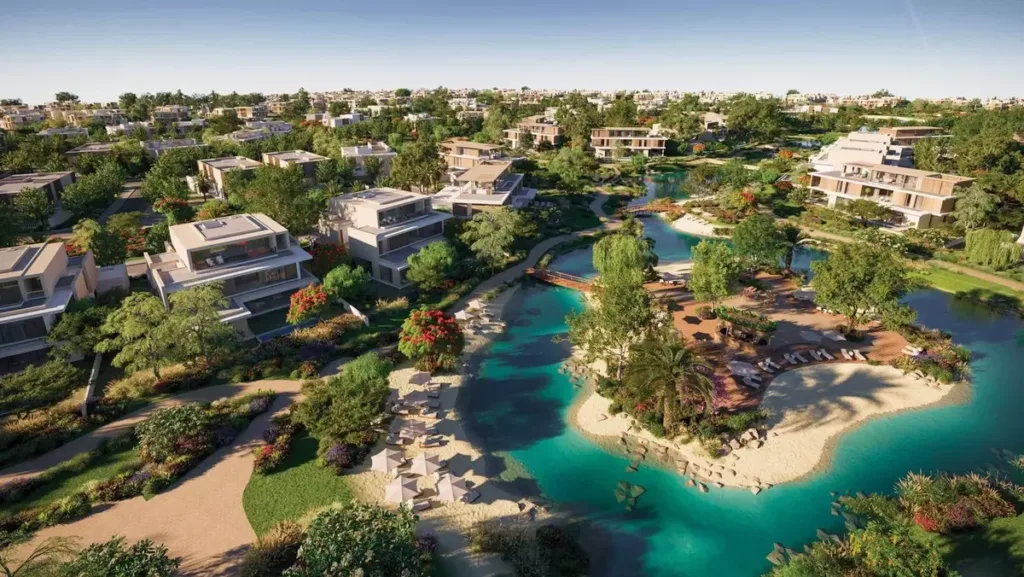
The community is built around its lagoon, beaches, landscaped areas and family-focused facilities.
The product mix is largely villas and townhouses, with different phases targeting different price segments.
The important point for buyers is that Tilal Al Ghaf is no longer simply a future concept. Parts of the community are already occupied while other phases continue to come to market.
That creates a different investment profile from a completely new master plan.
You can assess existing demand, nearby completed homes and the actual community environment while still having access to newer launches.
The Valley: Emaar’s growing suburban community
The Valley has become one of the most visible newer Emaar communities in the Dubailand corridor.
It sits along Dubai–Al Ain Road and focuses mainly on villas and townhouses.
Emaar lists a 61,000 sq m community area, a 47,000 sq m Golden Beach, 25,000 sq m Sports Village, 13,000 sq m Kids’ Dale, 32,000 sq m Town Centre and 3,000 sq m pocket park.
These numbers explain the community’s positioning.
The Valley is not designed around high-rise living. The focus is low-density family housing with outdoor recreation built into the master plan.
Emaar currently lists several residential phases, including Eden, Nara, Talia, Orania, Elora, Rivana, Nima, Alana and Farm Gardens.
For buyers, the big question is timing.
A newer community can offer a new home, modern layouts and attractive payment plans. But the full value of the master plan depends on continued delivery of homes and facilities.
Sobha Sanctuary: one of Dubailand’s biggest new bets
Sobha Sanctuary is one of the largest new communities to enter this part of Dubai.
Sobha says the master plan covers approximately 37.5 million sq ft and is designed for around 20,000 families.
The plan includes more than 50,000 trees, green corridors, walking and cycling routes, wellness facilities, sports areas, retail, schools and healthcare facilities. The first phase includes a limited release of roughly 250 villas.
The scale is worth watching.
A 37.5-million-sq-ft master plan is not comparable with a small residential project. Its long-term success will depend on how well the developer delivers the wider community.
For an investor, this creates a different type of opportunity.
You are not only buying a villa. You are taking exposure to the future positioning of a very large residential district.
That also means the investment should be assessed over a longer period.
Sobha Elwood: smaller and closer to the nature-led trend
Sobha Elwood follows the broader shift toward villa communities with more landscaping and outdoor space.
It is worth comparing with Sobha Sanctuary because both target buyers who want larger homes and a greener suburban setting.
The difference is scale.
Sobha Sanctuary is a major master-planned community. Elwood is a smaller residential development.
For buyers, that distinction matters because community scale can affect future retail, schools, amenities and resale demand.
Villanova: a proven townhouse and villa community
Villanova by Dubai Properties is another established family-oriented community.
Its clusters include Amaranta, La Quinta and La Rosa.
The community is known for townhouse and villa products rather than apartment towers.
That gives it a different buyer profile from apartment-heavy parts of Dubailand.
For families, the appeal is straightforward: more internal space, private outdoor areas and a suburban setting without moving too far from Dubai’s main road network.
Al Barari: a premium nature-led community
Al Barari sits at the premium end of the Dubailand market.
The community says its 15.3-million-sq-ft development preserves more than half of its area as green space. It includes villas, apartments, gardens, water features, wellness facilities, retail and restaurants.
This is a very different proposition from DAMAC Hills 2 or apartment-focused Dubailand locations.
The buyer is paying for land, privacy, landscaping and a low-density environment.
That makes Al Barari a useful benchmark when comparing high-end Dubailand properties.
Other Dubailand communities worth knowing
Dubailand is too large to reduce to five or six projects.
Other communities and residential areas include:
- Mudon — a Dubai Properties villa and townhouse community.
- The Villa — a large villa community with Spanish-inspired architecture.
- Living Legends — a golf-oriented residential development.
- Falcon City of Wonders — a themed residential community.
- Cherrywoods — a townhouse-focused community.
- Rukan — a mixed residential development with apartments, townhouses and villas.
- Arjan — an apartment-heavy district with substantial new supply.
- Liwan — an apartment-focused residential area.
- Remraam — a large affordable family-oriented apartment and townhouse community.
- Dubailand Residence Complex — mainly apartment-led residential development.
- DAMAC Lagoons — a newer DAMAC community built around a Mediterranean-inspired water theme.
- DAMAC Islands — a newer villa and townhouse concept within the wider Dubailand market.
DAMAC’s current community portfolio also lists DAMAC Riverside, DAMAC Sun City and newer DAMAC Islands phases within Dubailand.
This is why the term “Dubailand property” needs more detail.
A AED 1.5 million apartment in one part of Dubailand and a AED 5 million villa in another are technically in the same broad district, but they serve very different buyers.
How Dubailand communities compare
| Community | Main property type | Market position | Best suited to |
| Arabian Ranches | Villas & townhouses | Established premium | Families, end users |
| DAMAC Hills | Villas, townhouses & apartments | Established lifestyle | Families and investors |
| DAMAC Hills 2 | Villas, townhouses & apartments | Value-focused | Investors and budget-conscious buyers |
| Tilal Al Ghaf | Villas & townhouses | Premium lifestyle | Families and long-term buyers |
| The Valley | Villas & townhouses | Newer family community | End users and long-term investors |
| Sobha Sanctuary | Villas | New large-scale premium community | Long-term buyers |
| Sobha Elwood | Villas | Premium suburban | Families |
| Villanova | Villas & townhouses | Mid-to-upper suburban | Families |
| Al Barari | Villas & apartments | Ultra-premium nature-led | HNW buyers |
| Arjan | Apartments | Broad investor market | Investors and tenants |
| Liwan | Apartments | More accessible | First-time buyers and investors |
| Remraam | Apartments & townhouses | Value/family | End users and investors |
What makes Dubailand different from central Dubai?
The biggest difference is the type of housing.
Central Dubai is dominated by apartments.
Dubailand gives you far more access to villas, townhouses, larger floor plans and master-planned family communities.
That changes the investment calculation.
A villa may have a much higher purchase price than an apartment. But it can also attract families looking for longer tenancies and more living space.
At the same time, apartments can provide a lower entry point and a wider tenant pool.
So the right property depends on your objective.
If you want capital growth, study land scarcity, new infrastructure, developer reputation and the future supply pipeline.
If you want rental income, study actual rents, occupancy, service charges and tenant demand.
If you want a family home, focus more heavily on schools, daily retail, commuting time, parks and community facilities.
Is Dubailand a good investment in 2026?
The latest numbers suggest that buyers should take Dubailand seriously.
Bayut’s H1 2026 data showed an average Dubailand villa transaction value of about AED 2.93 million and an average ROI of 5.23% for the area in its affordable-villa comparison.
At the same time, the wider Dubailand price index has recorded strong year-on-year gains.
But price growth should not be the only reason to buy.
The area has a large development pipeline. That can support future population growth and amenities, but it also means new supply will continue to compete with existing properties.
For an investor, this makes the individual community more important than the Dubailand label.
A well-located villa in a mature community can behave very differently from an apartment in a new development with several competing launches nearby.
How to choose the right Dubailand community
Start with your budget.
Then decide what you actually need from the property.
If you want a family villa
Look first at:
- Arabian Ranches
- The Valley
- Tilal Al Ghaf
- Villanova
- Sobha Sanctuary
- Sobha Elwood
Compare plot size, built-up area, school access, community retail and handover status.
If you want a lower-cost villa investment
DAMAC Hills 2 deserves attention.
Its lower average transaction value and reported 6.03% ROI in Bayut’s H1 2026 comparison make it one of the more accessible villa markets in the wider Dubailand area.
If you want a premium property
Look at:
- Arabian Ranches
- Tilal Al Ghaf
- Al Barari
- Sobha Sanctuary
Here, the purchase price is only one part of the decision.
You should also compare land size, privacy, community quality, developer reputation and resale supply.
If you want an apartment
Look beyond the villa communities.
Arjan, Liwan, Remraam and Dubailand Residence Complex offer a different investment proposition.
Your focus should shift toward:
- Price per sq ft
- Rental yield
- Service charges
- Number of competing units
- Tenant profile
- Access to public transport and major roads
- Handover pipeline
The most important number is not always the price
A common mistake is comparing communities only by their starting price.
Suppose one villa costs AED 3 million and another costs AED 4 million.
The cheaper property is not automatically the better investment.
You need to compare at least seven numbers:
- Purchase price
- Price per sq ft
- Built-up area
- Plot size
- Expected annual rent
- Service and community charges
- Total cash required until handover
For off-plan property, add the payment schedule.
A AED 3 million property with a heavy payment requirement before handover can create a very different cash-flow profile from a AED 4 million property with a longer payment plan.
Dubailand’s biggest advantage is its range
That may be the most important point for buyers.
Dubailand is not one type of property market.
You can find established villa communities, new master plans, affordable apartments, premium villas, golf communities, lagoon projects and nature-focused developments within the broader district.
The market also continues to expand.
By July 2026, Bayut’s data showed Dubailand property prices had risen strongly over the previous year, while off-plan prices were also higher than a year earlier.
That gives buyers plenty of choice.
But choice also means you need to compare properties at the community level, not simply at the Dubailand level.
Final view: which Dubailand community is right for you?
There is no single best Dubailand community for everyone.
Arabian Ranches is stronger for buyers who value maturity and established family living.
DAMAC Hills 2 makes sense for buyers looking for a lower villa entry point and rental income potential.
Tilal Al Ghaf targets buyers who want a premium family community with a lagoon-led setting.
The Valley offers newer Emaar villa and townhouse stock with a large recreation-focused master plan.
Sobha Sanctuary is the long-term play for buyers who like large-scale development and a strong focus on green space.
Al Barari sits in a different category, aimed at buyers who want privacy, landscaping and premium homes.
And for apartment investors, Arjan, Liwan and Remraam deserve a separate analysis rather than being compared directly with villa communities.
The real opportunity in Dubailand is not simply that the area is large.
It is that Dubai is continuing to add homes, infrastructure and community facilities across a very large suburban corridor.
For buyers, that means the right question is simple:
Which community has the right combination of price, product, location, existing amenities and future supply for your investment period?
That is where a Dubailand property comparison becomes useful.