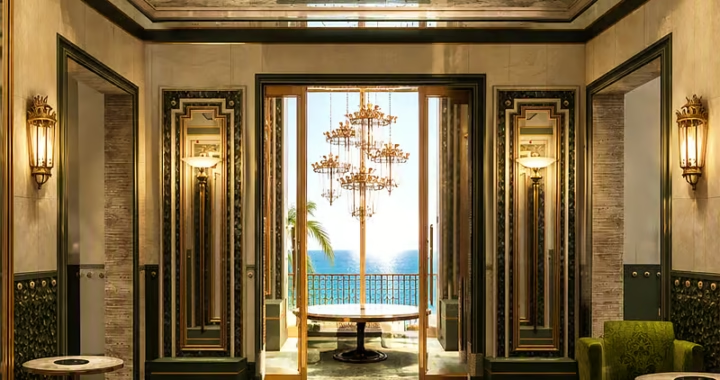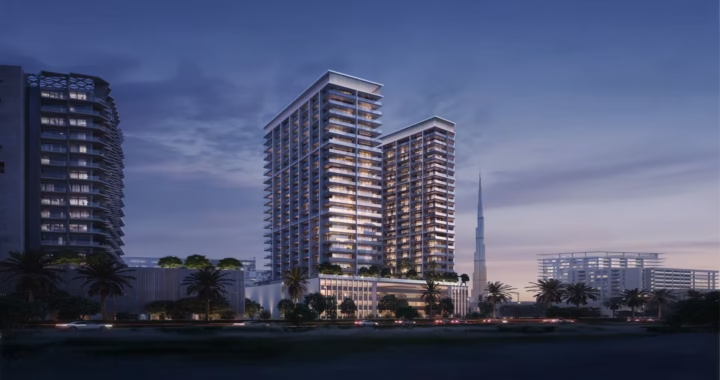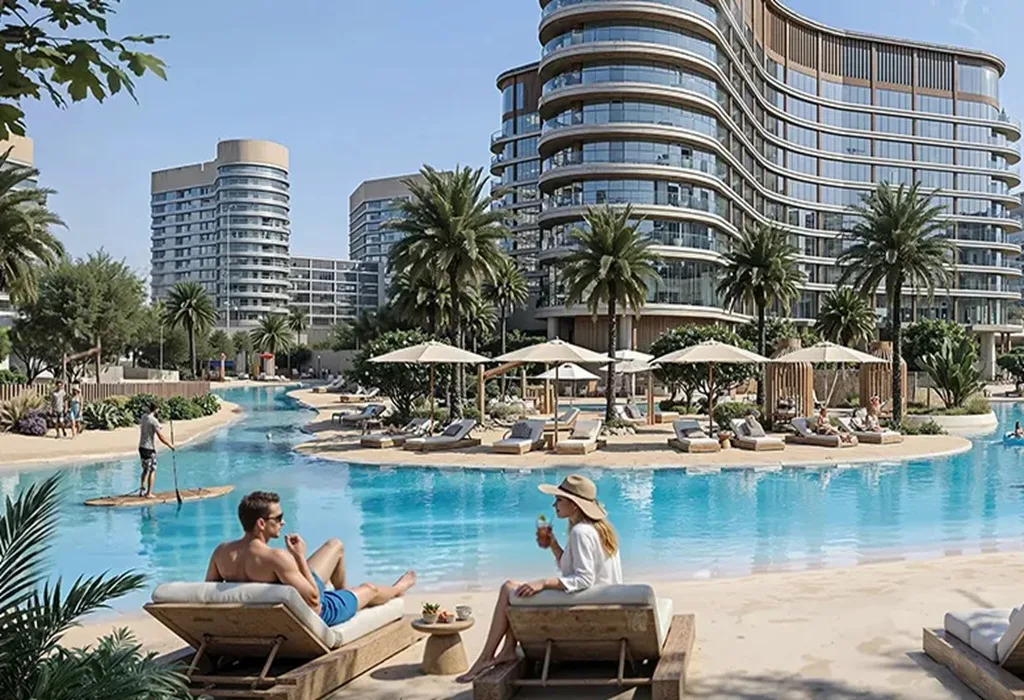
At first glance, Sobha Sanctuary and The Valley look like two versions of the same idea.
Both sit in Dubai’s outer residential growth belt. Both are built around greenery, open space and family living. Both give buyers an alternative to high-density apartment communities closer to Downtown Dubai. And both are being developed by two of Dubai’s biggest names in residential real estate: Sobha Realty and Emaar Properties.
But the similarities stop fairly quickly.
Sobha Sanctuary is being built as a very large, wellness-led master community with a mix of apartments and villas. The Valley has a stronger suburban town concept, with townhouses and villas at its core.
That difference matters.
A buyer looking for a family villa today should assess these communities differently from an investor buying an off-plan property with a four-year holding period. The same applies to someone comparing entry price, future resale liquidity, rental demand or the quality of the surrounding infrastructure.
Here is how I would look at the two communities from a property-buying and investment perspective.
The first thing to understand: these are not direct substitutes
The biggest mistake is to compare Sobha Sanctuary and The Valley simply because they are close to each other.
They serve overlapping but different buyer groups.
Sobha Sanctuary covers about 37.5 million sq ft and is planned as a much broader mixed-use community. Sobha says the development will include more than 50,000 trees, a central destination park of roughly 800,000 sq ft, green corridors and dedicated wellness and leisure loops.
The Valley, meanwhile, has established a clearer suburban identity around villas and townhouses. Emaar’s Phase 2 alone covers 200 hectares and more than 4,500 residential units, with green corridors and activity hubs connecting different neighbourhoods.
So the real comparison is:
Sobha Sanctuary = large-scale wellness and mixed-use masterplan
The Valley = suburban villa and townhouse community
That distinction should drive the buying decision.
Sobha Sanctuary is betting on the long-term masterplan
Sobha Sanctuary is one of the most ambitious developments launched by Sobha Realty in Dubai.
The masterplan is designed around the idea that greenery should sit between residential clusters rather than simply appear as landscaping around individual buildings.
The numbers are significant.
The development covers approximately 37.5 million sq ft and is planned around roughly 20,000 families. Sobha says more than 50,000 trees will form part of the landscape, supported by green corridors, walking routes, cycling routes and wellness-focused facilities.
The first residential releases are heavily focused on villas.
Sobha initially launched around 250 villas, with prices starting at approximately AED 3.99 million and handovers expected from the third quarter of 2029.
The current Sobha portfolio also shows several Sanctuary villa clusters, including The Brooks and The Greens, with 2029 handovers and different villa sizes and price points.
This creates an important distinction for buyers.
You are not simply buying a villa.
You are buying into an early phase of a much larger future community.
That can work very well if the masterplan develops as intended. But it also means today’s buyer has to be comfortable waiting for the wider ecosystem to mature.
The Valley has a different advantage: it is easier to understand
The Valley is simpler to explain to a buyer.
It is a suburban residential community built around townhouses, villas, green spaces, sports facilities, retail and family recreation.
Emaar’s own community information lists amenities including a 47,000 sq m Golden Beach, 13,000 sq m Kids’ Dale, 25,000 sq m Sports Village, 32,000 sq m Town Centre and 3,000 sq m pocket park.
This gives The Valley a strong family-use proposition.
Parents can understand what they are buying.
Children have play areas.
There are sports facilities.
There is a beach-style leisure area.
There is retail and dining planned around the Town Centre.
And the community is being delivered in phases rather than waiting for one enormous masterplan to reach completion.
That phased approach has an important property-market benefit: different parts of The Valley can become usable and recognisable while other phases are still being developed.
That is already visible in the delivery pipeline.
For example, DLD-linked construction data shows The Valley’s Elora and Farm Gardens projects reaching 100% completion in 2026. At the same time, newer projects such as Ovelle and Avelia are still in their early construction stages, with planned handovers in 2029.
So The Valley is no longer simply a future concept.
It is becoming a collection of completed, under-construction and newly launched neighbourhoods.
Where Sobha Sanctuary has the stronger proposition
If I were advising a buyer who cares deeply about green space, privacy and the quality of the residential environment, Sobha Sanctuary would deserve serious attention.
The reason is not simply the number of trees.
It is the amount of planning that goes into the spaces between homes.
Sobha’s masterplan includes a large central destination park, green corridors and separate wellness and leisure loops. The company describes a 9+ km wellness loop and a 5 km leisure loop, alongside meditation areas, hydrotherapy facilities, saunas, steam rooms and other wellness amenities.
That creates a different daily experience.
A resident can potentially walk or cycle through the community without treating the road network as the main public space.
For a premium villa buyer, this matters.
The quality of a villa is not determined only by its built-up area. The surrounding streets, landscaping, parks, privacy, traffic movement and access to community facilities all affect how the property feels five or ten years after purchase.
This is where Sanctuary has a potentially strong long-term proposition.
Where The Valley has the stronger proposition
The Valley’s advantage is its family-oriented recreational mix.
The Golden Beach is a particularly useful example.
A man-made beach inside a suburban villa community gives the development a leisure feature that is easy for buyers to understand and easy for agents to market.
The Sports Village adds another layer, while Kids’ Dale, pocket parks, jogging routes and the Town Centre create a more conventional family-community structure. Emaar’s Phase 2 also adds facilities such as soccer, tennis, padel, basketball, cycling, jogging routes, flower farms and other outdoor amenities.
The Valley therefore feels less like a wellness retreat and more like a large family neighbourhood with recreation built into the masterplan.
That can be important for resale.
When you eventually sell a townhouse, the buyer may care less about the technical description of the masterplan and more about practical questions:
- How close is the house to the park?
- How long does it take to reach the Town Centre?
- Is there a playground nearby?
- How accessible are the sports facilities?
- Is the community already active?
- What are the surrounding homes selling for?
- How soon can I move in?
The Valley is gradually building that real-world evidence.
Price is where the comparison gets interesting
The Valley historically offered a lower entry point than Sanctuary’s first villa releases.
That made it attractive to buyers who wanted an Emaar townhouse or villa without moving directly into Dubai’s higher-priced established villa communities.
But buyers should be careful with simple “starting price” comparisons.
A AED 2 million townhouse and a AED 4 million villa are not necessarily comparable investments.
The better comparison is:
Price ÷ built-up area
and then:
Price ÷ plot area
followed by:
expected rent ÷ total acquisition cost
This is particularly important in The Valley because different phases contain materially different property types.
The current official The Valley website, for example, lists selected homes from around AED 2.4 million, while some newer five-bedroom products start substantially higher.
Sobha’s current Sanctuary listings also show a wide spread.
The Greens, for example, are listed from around AED 4.07 million, while The Brooks is listed from approximately AED 7.29 million.
So the old comparison of “The Valley is cheaper and Sanctuary is expensive” is too simplistic.
There is now meaningful variation inside both communities.
The handover difference changes the investment strategy
This is one of the most important differences between the two.
Sobha Sanctuary is still in its early development cycle.
The initial villa launches are scheduled for 2029, and Sobha’s current Sanctuary apartment listings also show 2029 handovers.
The Valley has a much wider delivery spectrum.
Some projects have already reached completion, while newer launches are scheduled for 2029 and 2030.
That creates two different investment profiles.
Sanctuary suits the longer holding period
A Sanctuary buyer has more time between purchase and handover.
That means the investment case depends heavily on:
- construction progress
- future infrastructure
- surrounding development
- Dubai population growth
- future villa demand
- the success of the overall masterplan
There is potentially more development-led upside, but there is also a longer wait before the asset becomes income-producing.
The Valley gives more reference points
With completed and near-completed phases, investors can increasingly look at actual transactions rather than relying entirely on launch prices and forecasts.
For example, DLD-linked data for Elora shows registered sales at a median of about AED 1,617 per sq ft in 2026, compared with AED 1,109 per sq ft in 2023. That is useful evidence of how values have moved within one completed Valley project, although it should not be treated as a guaranteed future return.
This is one of The Valley’s strongest advantages for an investor.
You have more historical evidence to work with.
What about rental income?
This is where I would be careful.
Neither community should be judged purely on headline rental yield today because the property mix, handover timing and individual location inside the masterplan can materially change the result.
For Sanctuary, the 2029 handover means today’s buyer is primarily making a capital-growth and long-term community-development bet.
The rental calculation comes later.
For The Valley, some properties are already completed or approaching completion. That gives investors a clearer path to studying actual rents and occupancy once comparable homes are available.
But there is another factor.
Villa rental demand is highly sensitive to the quality of the surrounding community.
Families renting a three- or four-bedroom townhouse are not simply looking for four walls.
They want schools, supermarkets, parks, play areas, road access and a community that feels complete.
That is why the Town Centre, Sports Village and recreational facilities matter commercially, not only from a lifestyle perspective.
The apartment component makes Sanctuary a different investment story
This is a major point that is easy to miss.
The long-term Sanctuary plan is not exclusively a villa community.
Sobha has indicated a substantial apartment component within the overall masterplan, and its current listings include The Woods Abode and The Woods Serenity, both offering one- and two-bedroom apartments with 2029 handovers.
That changes the future population structure.
The Valley’s core identity remains much more strongly associated with villas and townhouses.
Sanctuary is therefore likely to have a broader range of residents over time:
- villa owners
- townhouse residents
- apartment owners
- tenants
- families
- professionals
- investors
That can help create a more complete urban ecosystem.
But it also means Sanctuary may eventually have a much larger population.
For an investor, that has both advantages and disadvantages.
A larger resident base can support retail, schools, healthcare and community services.
At the same time, a larger number of units can mean greater competition when apartments and similar homes enter the rental market.
Which developer has the advantage?
This is not an easy winner.
Emaar has the stronger track record of creating large, recognisable residential communities in Dubai.
Its portfolio includes communities such as Arabian Ranches and Dubai Hills Estate, giving buyers a long history of seeing how Emaar masterplans develop over time.
Sobha’s advantage is different.
The developer has built its reputation around construction quality, internal execution capabilities and detailed finishing.
For a villa buyer, that can matter considerably.
A house is a physical product that you may live in for 10 or 20 years.
The quality of doors, kitchens, bathrooms, flooring, façade materials, landscaping and common infrastructure affects the ownership experience.
So the developer decision should not be reduced to brand recognition.
Ask instead:
Do I value Emaar’s established community track record more, or Sobha’s construction and product positioning?
That is a much more useful question.
Location: both benefit from the same broad growth story
Both communities are positioned around the Dubai–Al Ain Road corridor.
The location is important because Dubai’s residential growth is increasingly spreading outward from the traditional central districts.
The Valley’s official material highlights access via Dubai-Al Ain Road and its proximity to major future growth areas, including Al Maktoum International Airport.
Sanctuary sits in the same broader Al Yufrah/Dubailand growth belt.
This means buyers are not only betting on the individual community.
They are also betting on the expansion of Dubai’s southern and southeastern residential infrastructure.
That can be a strong long-term theme.
But buyers should not confuse future connectivity with today’s convenience.
If your daily life requires frequent trips to Downtown Dubai, DIFC or Business Bay, the commute deserves serious consideration.
If your priorities are family space, schools, community facilities and a larger home, the location becomes more attractive.
Density: the more useful comparison
Both developments are designed to provide a lower-density alternative to central Dubai.
But the type of density is different.
The Valley’s low-rise character is central to its identity.
You mostly think of streets lined with townhouses and villas, parks and recreational spaces.
Sanctuary has a broader mix.
It combines large villa clusters with future apartment communities and extensive landscaped areas.
That means Sanctuary could eventually feel like a larger urban district with a green residential structure, while The Valley feels more like a suburban town made up of family neighbourhoods.
For a villa buyer, The Valley’s consistent low-rise character may be attractive.
For someone who wants a larger community with more housing types and services, Sanctuary may have the stronger long-term proposition.
Buying and Checklist Guide
The masterplan brochure is only the first step.
Before paying a booking amount, I would compare the specific property on seven points.
1. Exact location inside the community
A villa beside a park is not equivalent to one beside a main road.
Internal location can influence privacy, noise, views and resale demand.
2. Plot size
Do not compare only built-up area.
Two villas with similar built-up areas can have very different plot sizes.
3. Price per sq ft
Calculate this using the same measurement basis for both properties.
4. Payment schedule
A lower booking price does not automatically mean lower investment cost.
Calculate how much cash you need every six months until handover.
5. Handover date
This affects both your capital requirements and the date when the property can potentially generate rent.
6. Comparable resale transactions
This becomes particularly important in The Valley because there is already transaction history from completed phases.
7. Future supply around your unit
This matters more for investors than many buyers realise.
If dozens of similar villas are handed over at the same time, landlords may compete for the same tenant pool.
Sobha Sanctuary vs The Valley: my assessment
| Factor | Sobha Sanctuary | The Valley |
| Community concept | Wellness-led master community | Family-focused suburban town |
| Developer | Sobha Realty | Emaar |
| Scale | ~37.5M sq ft | Phase 2 alone: 200 hectares |
| Core property types | Villas + apartments | Villas + townhouses |
| Villa positioning | More premium in initial releases | Broader range |
| Green infrastructure | Major focus | Major focus |
| Leisure proposition | Wellness, parks, trails, sports | Beach, sports, parks, Town Centre |
| Current maturity | Early-stage | Mixed: completed + under construction + new launches |
| Handover profile | Mainly 2029 for current Sanctuary launches | 2026–2030 depending on phase |
| Best suited to | Long-term premium buyers | Families and investors seeking different entry points |
| Main investment attraction | Future masterplan + premium villa positioning | Established transaction evidence + phased delivery |
| Main consideration | Longer wait for full community maturity | Large pipeline means careful phase selection |
So, which one should you buy?
If your budget allows around AED 4 million or more and your priority is a premium villa in a new green master community, I would give Sobha Sanctuary serious consideration.
The attraction is the scale of the masterplan, the large amount of planned greenery, the wellness infrastructure and the premium positioning of the initial villa releases.
But I would treat it as a long-term investment, not a quick resale trade.
The Valley makes more sense if you want Emaar, a family-oriented villa/townhouse community and a wider range of entry points.
It also has an important advantage: parts of the community are already reaching completion, giving buyers actual construction and transaction evidence.
For investors, that matters.
You can study what buyers are paying.
You can inspect completed homes.
You can assess the community physically.
You can compare resale listings.
And you can build a rental estimate using increasingly relevant local comparables.
My view for different buyers
For a family planning to live in Dubai:
The Valley gets the edge if you want a more established community environment sooner.
For a premium villa buyer with a 7–10 year horizon:
Sobha Sanctuary becomes more interesting because of its scale, landscaping and planned wellness infrastructure.
For an investor focused on capital appreciation:
I would compare the specific unit rather than automatically choosing the developer. Entry price, plot, location within the community and payment schedule matter more than the project name alone.
For an investor wanting earlier rental visibility:
The Valley has the advantage because completed phases provide better real-world evidence.
For buyers focused on construction quality:
Sobha deserves serious consideration.
For buyers who prioritise a proven Dubai master-community track record:
Emaar has the stronger reference base.
The bottom line
Sobha Sanctuary and The Valley are close geographically, but they are developing into different products.
The Valley is the easier choice to understand today.
It has a strong family identity, low-rise homes, recreational facilities and a growing body of completed and under-construction projects.
Sobha Sanctuary is the more ambitious long-term proposition.
Its 37.5-million-sq-ft masterplan, large green network, 50,000-plus trees, wellness facilities and broad residential mix give it the potential to become a major residential destination in its own right.
The important word is potential.
Sanctuary still has years of development ahead.
That makes the purchase decision more dependent on the future masterplan.
The Valley gives you more evidence today.
Sanctuary asks you to think further ahead.
For that reason, I would not ask “Which project is better?”
I would ask:
“Do I want to buy into a community that is already taking shape, or do I want to enter earlier into a much larger masterplan and wait for its full value proposition to develop?”
That is the real difference between Sobha Sanctuary and The Valley.