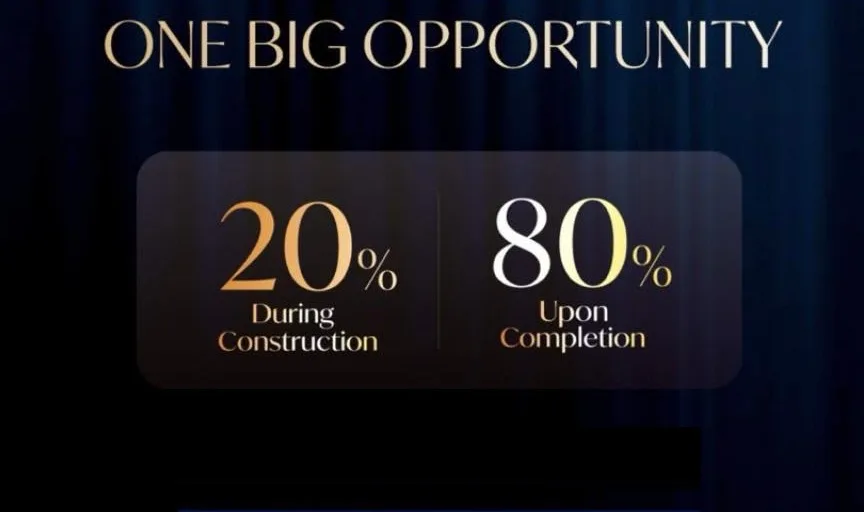
A 20/80 payment plan sounds attractive.
You pay 20% while the property is being built. The remaining 80% comes due at handover.
For a buyer, that changes the cash-flow equation. You do not need to commit most of your capital during construction.
But there is an important point that often gets missed.
A better payment plan does not automatically mean a better property investment.
Sobha’s recent promotional campaign shows why buyers need to look beyond the headline offer. The 20/80 structure was promoted across selected Sobha projects, along with incentives such as DLD waivers, service-charge waivers and furniture vouchers. The published offer ran August 2026, with project-specific eligibility
So, what does the offer really mean for a buyer?
Visit the link – Sobha 20/80 Payment Plan: A Smarter Way to Buy Property
What does Sobha’s 20/80 payment plan mean?
The basic structure is simple:
- 20% during construction
- 80% at handover
- Selected projects also offered DLD or registration-fee incentives
- Some projects included service-charge waivers
- Sobha Elwood included a furniture voucher
- Several projects had a AED 5 million minimum unit value
- Sobha Central was the major exception, with no minimum unit value under the published offer.
The structure can make a large property purchase easier to manage.
But it also moves a large financial obligation into the future.
That distinction matters.
The 80% is still your money
Consider a simple AED 5 million property.
Under a 20/80 structure:
| Payment | Amount |
| Purchase price | AED 5,000,000 |
| 20% during construction | AED 1,000,000 |
| 80% at handover | AED 4,000,000 |
| 4% DLD | AED 200,000 |
If the full 4% DLD fee is waived, that represents a potential AED 200,000 saving.
But you still have AED 4 million to fund at handover.
That is the part buyers need to plan for before signing.
Which Sobha projects were included?
The offer covered several projects, but the incentives were not identical.
Sobha Elwood
The published offer for Sobha Elwood included:
- 20/80 payment plan
- 2% DLD waiver
- 2% furniture voucher
- AED 5 million minimum unit value
- Villas valued at AED 5 million or above.
This is important because the headline “20/80” does not tell you the full offer.
The extra benefits can change the effective acquisition cost.
But they should still be treated as incentives rather than a reason to buy the property.
Sobha Sanctuary
Sobha Sanctuary had different terms depending on the villa type.
Courtyard and Garden Villas were offered with:
- 20/80 payment plan
- 2% DLD waiver
- Two-year service-charge waiver
Estate Villas were offered with:
- 20/80 payment plan
- 4% DLD waiver
The published minimum unit value was AED 5 million.
That difference is worth noting.
A buyer looking only at “Sobha Sanctuary 20/80” could miss a significant difference in the incentive package.
Sobha Central
Sobha Central stands out because the published offer did not have the AED 5 million minimum.
The terms included:
- 1-bedroom apartments: 20/80
- 2% DLD waiver
- Two-year service-charge waiver
- 2- and 3-bedroom units: 20/80
- 4% DLD waiver.
This makes the offer relevant to a much wider buyer group.
It also means buyers should compare units by price per sq ft, layout, floor, view and expected rent, rather than simply comparing payment plans.
Sobha Siniya Island and Umm Al Quwain
The promotion also extended outside Dubai.
Sobha Siniya Island and Downtown Umm Al Quwain were offered on a 20/80 structure with a 100% registration-fee waiver, subject to the published eligibility terms. Both carried a AED 5 million minimum under the promotion.
That creates an interesting comparison.
A Dubai buyer may focus on the DLD saving, while an investor looking at Umm Al Quwain needs to think more about:
- Rental demand
- Resale depth
- Future infrastructure
- Local population growth
- Tourism demand
- Exit liquidity
The payment plan is only one part of that calculation.
The biggest risk is not the 20%. It is the 80%
This is where I think buyers need to be more careful.
Imagine you buy a AED 6 million villa.
You have to fund:
AED 1.2 million during construction
and then:
AED 4.8 million at handover.
What happens if your financial position changes?
What if your mortgage approval is lower than expected?
What if your existing property has not sold?
What if the secondary market is softer when you reach handover?
The payment plan does not remove these risks.
It simply pushes the largest payment into the future.
That can be useful if you have a strong funding plan.
It can become a problem if you are relying on a future resale to fund the balance.
Do not assume you can flip after paying 20%
This is another point buyers should check carefully.
A common off-plan strategy is:
Buy → pay initial instalments → sell before handover.
That can work in the right market.
But you should never assume that paying 20% automatically means you can resell.
Check the developer’s current NOC and resale conditions before buying.
Also check:
- Minimum percentage paid before resale
- NOC charges
- Outstanding instalments
- Assignment restrictions
- Registration requirements
- Any promotional conditions attached to the unit
The exact contractual terms should come from the booking documents and Sale & Purchase Agreement.
A DLD waiver can be worth real money
This part deserves some credit.
Dubai’s standard DLD transfer fee is 4% of the purchase price.
So the value of a full waiver increases quickly as the property price rises.
| Property price | 4% DLD | Potential saving |
| AED 2M | AED 80,000 | AED 80,000 |
| AED 3M | AED 120,000 | AED 120,000 |
| AED 5M | AED 200,000 | AED 200,000 |
| AED 7M | AED 280,000 | AED 280,000 |
| AED 10M | AED 400,000 | AED 400,000 |
That is meaningful money.
But there is a simple rule:
Never pay AED 500,000 extra for a property because the developer is giving you AED 200,000 back in incentives.
Compare the actual property price with competing units.
The real question is the price per square foot
This is where a buyer’s analysis should start.
Suppose two villas both qualify for a 20/80 plan.
Villa A:
- AED 5 million
- 3,000 sq ft
- AED 1,667 per sq ft
Villa B:
- AED 5.5 million
- 3,500 sq ft
- AED 1,571 per sq ft
Villa B costs AED 500,000 more.
But it is actually cheaper on a built-up-area basis.
The same principle applies to apartments.
Do not compare payment plans first.
Compare the underlying asset first.
What about rental returns?
This is another area where the 20/80 structure can create confusion.
A payment plan does not determine rental yield.
Suppose a AED 5 million property generates AED 250,000 in annual rent.
The gross yield is:
5%
If the property generates AED 350,000:
7%
The payment structure has not changed either calculation.
Your return comes from the relationship between:
Purchase price + acquisition costs + ownership costs + rental income + eventual resale value.
That is why buyers should calculate the expected net yield, not just the advertised rent.
Service charges, maintenance, vacancy, management and other costs can reduce the amount you actually keep.
The handover problem deserves more attention
There is another issue worth considering.
Imagine hundreds of investors buy properties with large balances due at handover.
Some will have enough cash.
Some will use mortgages.
Some will sell another property.
Others may try to sell the off-plan unit before completion.
If many owners need to exit around the same period, resale competition can increase.
That does not mean prices will fall.
It means investors should not build their entire strategy around an assumption that the property will always be easy to sell before handover.
Exit liquidity matters.
20/80 versus a construction-linked payment plan
A construction-linked plan spreads payments according to project progress.
A 20/80 plan does something different.
It keeps the buyer’s construction-period payments low and moves most of the obligation to completion.
Neither structure is automatically better.
For a buyer with strong cash reserves, a construction-linked plan may feel more comfortable because the liability grows alongside the project.
For a buyer expecting a major liquidity event before handover, 20/80 may provide more flexibility.
The right answer depends on your funding position.
Do not compare Sobha’s offer only with Sobha
This is one of the most useful checks you can make.
If you are considering a AED 5 million Sobha villa, compare it with similar villas from other major developers.
Look at:
- Price per sq ft
- Plot size
- Built-up area
- Community size
- Number of units
- Handover date
- Service charges
- Rental potential
- Recent resale transactions
- Developer delivery record
- Future competing supply
Then compare the payment plans.
A 20/80 plan may look attractive until you find a similar property at a lower entry price with a 40/60 plan.
At that point, the question changes.
You are no longer asking:
“Which developer gives me the best payment plan?”
You are asking:
“Which property gives me the better risk-adjusted value?”
A simple way to assess the Sobha 20/80 offer
Before paying a booking amount, run these five numbers.
1. Total purchase cost
Include:
Property price + DLD/registration + agency fee + mortgage costs + other charges
Do not calculate the investment using the advertised property price alone.
2. Amount due before handover
Write down the exact cash required before completion.
For a AED 5 million 20/80 purchase, that headline number is AED 1 million.
But your actual contractual schedule may include additional charges.
3. Handover liability
Write the remaining amount in large numbers.
For AED 5 million:
AED 4 million
For AED 7 million:
AED 5.6 million
For AED 10 million:
AED 8 million
That number should be comfortable for you even if your resale plan fails.
4. Expected net rental yield
Do not use gross rent alone.
Estimate:
Annual rent − operating costs ÷ total investment
Then compare the result with alternative properties.
5. Exit price
This is the hardest number to predict.
Do not assume prices will rise simply because the property is from a well-known developer.
Look at current transactions and competing future supply.
Is Sobha’s 20/80 offer worth considering?
Yes, but the payment plan itself is not the reason to buy.
The offer can be useful for buyers who want to preserve capital during construction. The DLD and other incentives can also reduce acquisition costs.
The numbers become especially meaningful on high-value properties.
For example, a full 4% waiver on a AED 5 million property is AED 200,000. On AED 10 million, it is AED 400,000.
That is a genuine financial benefit.
But the buyer still needs to solve the biggest question:
Where will the remaining 80% come from?
If you already have a clear funding plan, the structure can work well.
If the plan is simply “I will sell the property before handover,” the risk is much higher.
Final verdict: treat 20/80 as a financing tool, not an investment thesis
Sobha’s 20/80 promotion is attractive because it changes when you pay, and in some cases reduces acquisition costs.
It does not change the fundamental economics of the property.
The smart approach is simple:
First assess the property. Then assess the price. Then assess the rental and resale potential. Only after that should you assess the payment plan.
A good property with a sensible price can benefit from 20/80.
A poor investment does not become good because you only pay 20% during construction.
And that is probably the most useful lesson from the recent discussion around Sobha’s 20/80 offers.
Offer terms referenced above were published for Sobha’s August 2026 campaign. Promotional terms can change, so buyers should verify the current booking form and Sale & Purchase Agreement before committing.