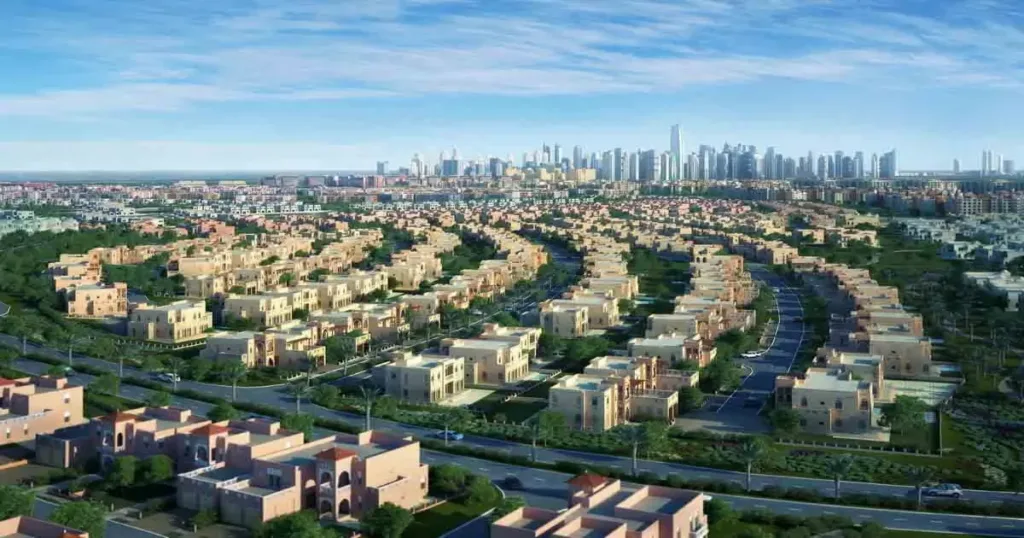
Downtown Jebel Ali and Al Furjan sit in the same broad part of Dubai, but they offer a different experience to buyers and investors. On a map, the two communities can look like natural alternatives. Both have access to major roads. Both benefit from Dubai Metro connectivity. Both are close to employment centres in the southern part of Dubai.
But the property story is different.
Al Furjan is an established residential community. It has a wider mix of apartments, townhouses and villas, along with schools, clinics, parks, retail and community facilities.
Downtown Jebel Ali has a stronger employment and industrial connection. It sits close to Jebel Ali Port, JAFZA and major logistics and business activity. Its residential market is still taking shape, with a large share of current supply coming from new developments.
That difference matters.
If you want a community where residential demand has already been tested over several years, Al Furjan has an advantage.
If you want a lower entry point and are comfortable buying into an area that is still developing, Downtown Jebel Ali can be worth a closer look.
Downtown Jebel Ali vs Al Furjan: the basic difference
The simplest way to understand the two markets is to look at what drives demand.
Al Furjan is mainly a residential story.
People choose it because they want access to homes, schools, parks, retail and transport without paying the prices seen in Dubai’s prime central districts.
Downtown Jebel Ali has a stronger employment-led story.
The area is linked to JAFZA, Jebel Ali Port, logistics, manufacturing and other commercial activity. That creates a natural pool of workers who may prefer to live close to their workplace.
This can matter for rental property.
A tenant working in or around Jebel Ali may care less about living near Downtown Dubai and more about commute time, Metro access, parking and monthly rent.
That is where Downtown Jebel Ali can make sense.
Al Furjan has a more established residential environment
Al Furjan has had years to build its residential base.
Dubai Holding Communities says the community covers about 560 hectares and has more than 4,600 homes. Its facilities include parks, playgrounds, swimming pools, sports areas, nurseries, clinics, retail and other daily services.
The education network is another advantage.
Property Finder’s current area data lists 12 schools within 5 km of Al Furjan, with UK curricula being the most common. The list includes The Arbor School, Delhi Private School, The Winchester School and Dubai British School Jumeirah Park.
That gives Al Furjan a stronger appeal to families.
A family looking for a long-term home is usually thinking about more than the apartment itself.
They may ask:
- How far is the school?
- Where will we buy groceries?
- Is there a park nearby?
- How easy is the Metro?
- Can we reach Sheikh Zayed Road quickly?
- Are clinics and pharmacies close?
- What type of homes are available when the family grows?
Al Furjan already has answers to many of these questions.
Downtown Jebel Ali is still building that residential ecosystem.
Downtown Jebel Ali has a different demand engine
Downtown Jebel Ali is closely connected to one of Dubai’s major employment corridors.
Jebel Ali Port and JAFZA create a large employment base. The area also has access to Sheikh Zayed Road and the Dubai Metro network.
This creates a practical rental proposition.
A professional working in Jebel Ali may not need a large villa in a family-focused community. A studio or one-bedroom apartment near the workplace and Metro can be enough.
That makes smaller apartments particularly relevant to investors.
Current projects show how low the entry point can be in some Downtown Jebel Ali projects. New listed projects such as Azizi Lina from around AED 601,000, Raw District from about AED 649,000, and Raw District 2 from about AED 666,000. These are launch prices and can change as inventory moves.
Other current listings show studios below AED 600,000 in some projects. That puts parts of Downtown Jebel Ali into a price bracket that can be difficult to access in many established Dubai communities.
The important point is not that every property is cheap.
It is that the entry price creates a different investment proposition.
Property prices show the gap
The difference becomes clearer when you look at price per square foot.
Bayut’s July 2026 data puts the average sale price across Al Furjan properties at about AED 1,469 per sq ft.
For apartments, the figure is about AED 1,443 per sq ft. A one-bedroom apartment averages about AED 1,448 per sq ft, while a two-bedroom apartment is around AED 1,420 per sq ft.
Downtown Jebel Ali is showing a lower entry point in several current off-plan projects.
Prop971’s latest market data shows a 12-month median sale price of AED 1,583 per sq ft, with about 88% of the area’s transactions over that period being off-plan. Its recent median prices are about AED 702,000 for studios, AED 1.13 million for one-bedroom units and AED 1.67 million for two-bedroom units.
These figures should not be treated as a direct apples-to-apples comparison.
The unit mix is different. Project quality is different. Building age, floor, view, payment plan and handover date can change the price substantially.
That is why a buyer should compare specific units, not only community averages.
Rental demand tells another part of the story
Al Furjan has a broad tenant base.
You can find young professionals, couples, families and residents looking for larger homes.
Bayut’s July 2026 rental index puts Al Furjan’s overall property rent at about AED 99 per sq ft. Apartment rents are around AED 106 per sq ft. A one-bedroom apartment is around AED 100 per sq ft, while a two-bedroom is around AED 94 per sq ft.
Another market dataset records a median annual residential rent of about AED 60,000 in Al Furjan over the last 12 months, although the figure varies significantly by property type.
This gives investors a useful reference point.
But gross rent alone does not tell you the return.
Suppose two apartments each cost AED 1 million.
One generates AED 65,000 in annual rent.
The other generates AED 75,000.
The second property has the stronger gross yield before service charges, maintenance, vacancy and other costs.
That is the comparison investors should make.
Metro access is a major link between the two communities
Both areas benefit from Dubai Metro connectivity.
Route 2020 opened with stations serving Jebel Ali, The Gardens, Discovery Gardens and Al Furjan. The RTA says the journey between Jebel Ali and Al Furjan stations takes about six minutes.
Jebel Ali Station is also an interchange point between the Red Line and Route 2020.
The station can handle up to 17,000 riders per hour during peak periods and up to 320,000 riders per day, according to the RTA.
That makes Metro proximity more than a marketing phrase.
For a rental investor, it can influence the tenant pool.
A tenant without a car may place a high value on being able to reach work by Metro.
A buyer who plans to rent out a studio or one-bedroom apartment should therefore check the actual walking or driving distance to the station, rather than simply relying on a project description that says “near Metro.”
A difference of five minutes can matter.
Why is Al Furjan Right for families?
The strongest case for Al Furjan is not simply its property price.
It is the wider residential environment.
The community has parks, retail, sports facilities, nurseries, clinics and established housing. The nearby school network also supports family demand.
There is also a broader choice of housing.
A buyer can move from an apartment to a townhouse or villa without necessarily leaving the wider community.
That gives Al Furjan a useful feature for families planning to stay for several years.
For an investor, this can also mean a wider tenant pool.
A one-bedroom apartment may target young professionals.
A two- or three-bedroom apartment can target families.
Townhouses and villas open another part of the rental market.
Downtown Jebel Ali is more concentrated around apartment-led development at present.
That can be an advantage if your investment strategy is focused on smaller units.
Why Downtown Jebel Ali Appeal to Investor
Downtown Jebel Ali has a different risk-and-return profile.
A number of current projects are being sold at prices below AED 1 million for studios and some smaller apartments. Property Finder currently shows hundreds of off-plan apartment listings across the area, with several projects scheduled for handover between 2027 and 2029.
That gives buyers more payment-plan options.
It also means more competition.
This is an important point that is sometimes missed.
Buying early in a developing area does not automatically mean strong capital growth.
The investor is also buying into future supply.
If several buildings hand over at the same time, landlords may compete for the same tenants. Rents can then depend heavily on building quality, location, amenities and asking price.
So the question is not:
“Will Downtown Jebel Ali grow?”
A better question is:
“Will this particular property remain competitive when the surrounding supply is completed?”
That is a much more useful investment test.
Downtown Jebel Ali vs Al Furjan: Rental proposition?
There is no single answer. It depends on the unit.
For example, a well-priced studio close to a Metro station in Downtown Jebel Ali could appeal strongly to a professional working nearby.
An older apartment with a poor layout and higher service charges may not.
The same principle applies to Al Furjan.
A one-bedroom apartment with good access, sensible service charges and strong building management can perform well.
A more expensive unit with a weak rental premium may produce a lower return.
For investors, the calculation should include:
Gross rental yield = Annual rent ÷ Purchase price × 100
Then go one step further.
Subtract:
- Service charges
- Maintenance
- Vacancy
- Leasing costs
- Property management fees
- Financing costs, if applicable
That gives you a much clearer view of the actual investment.
Who should consider Downtown Jebel Ali?
Downtown Jebel Ali can suit buyers who have a clear reason for choosing the area.
It may be worth considering if you are:
- Looking for rental income from smaller apartments
- Buying your first Dubai property
- Working around Jebel Ali or JAFZA
- Looking for a lower entry price than many established Dubai districts
- Comfortable with off-plan property
- Investing for five years or longer
- Looking for Metro-connected housing
- Comfortable with an area that is still developing
- Willing to accept future construction and new supply
- Focused on the numbers rather than buying purely for community reputation
The last point is important.
Downtown Jebel Ali is not necessarily the right choice because it is “up and coming.”
It needs to work for your specific property.
Who may be better suited to Al Furjan?
Al Furjan may make more sense if your priority is an established residential setting.
It can suit:
- Families with children
- Buyers planning to live in the property
- Investors looking for a broad tenant pool
- Buyers who want apartments, townhouses and villas in the same wider community
- Owners who value established retail and community facilities
- Investors who prefer a more mature residential market
- Buyers who want easier comparison with existing rental properties
Al Furjan also gives buyers more evidence to work with.
There are established buildings.
There are existing rents.
There are completed communities.
There are resale transactions.
That makes underwriting easier.
The real choice is maturity versus entry point
This is the most useful way to compare Downtown Jebel Ali and Al Furjan.
Al Furjan gives you a more established residential market.
You can see the community today.
You can inspect completed buildings. You can check current rents. You can compare similar apartments. You can speak to existing tenants.
Downtown Jebel Ali gives you more exposure to a developing residential market.
The entry price can be attractive in selected projects. Employment connectivity is strong. Metro access is useful. But more of the investment case depends on what happens as new projects are completed.
Neither approach is automatically better.
They simply suit different buyers.
A simple example for an investor
Imagine you have a budget of AED 1 million.
In Downtown Jebel Ali, that budget can give you access to several studio and one-bedroom off-plan options, depending on the project and payment plan. Current listings show projects starting below AED 700,000 in some cases.
In Al Furjan, the same budget may give you fewer options or require a smaller unit, depending on the building and whether you are buying off-plan or ready property.
But price is only the first calculation.
You should then ask:
What will the property rent for after handover?
How many similar units will compete with it?
What are the annual service charges?
How close is it to the Metro?
Who is the likely tenant?
What will the property look like when I want to sell it?
These questions are more important than simply choosing the community with the lower starting price.
Downtown Jebel Ali vs Al Furjan: final verdict
Al Furjan is the safer choice for a buyer who values an established residential environment.
Its housing stock is broader. Its family infrastructure is stronger. Its tenant base is wider. Its current market also gives investors plenty of completed properties to use as rental and resale comparisons.
Downtown Jebel Ali is a different proposition.
It is more closely tied to employment around Jebel Ali and JAFZA. It has strong road and Metro connectivity. Several new projects offer entry prices below AED 1 million. But much of the residential market is still being built, and future supply needs to be part of every investment calculation.
So the decision can be reduced to two questions:
Do you want the maturity of Al Furjan?
Or:
Are you comfortable taking more development risk in Downtown Jebel Ali in return for a potentially lower entry point?
For a first-time Dubai investor, that distinction is important.
Do not compare the two communities only by their starting prices.
Compare the purchase price, price per sq ft, expected rent, gross yield, service charges, payment plan, handover date, Metro access and competing supply for the exact properties you are considering.
That is where the better investment decision usually becomes clear.